








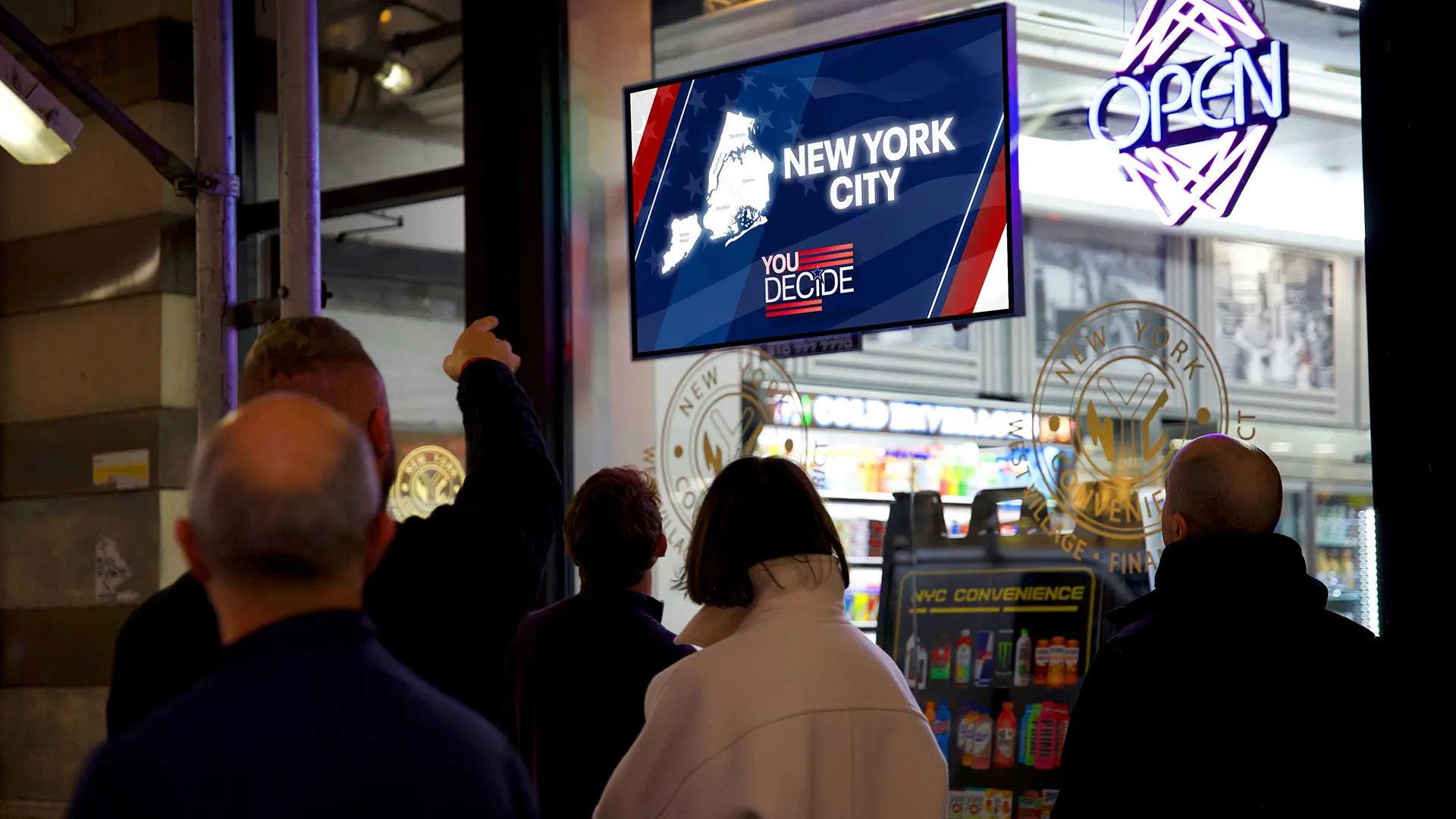

Political campaigns are investing in programmatic video to reach voters across a fragmented media landscape. But as more campaigns use CTV and CTV OOH, an important planning question is emerging:
Are these channels being used together, or are they still being treated as separate tactics?
At VideoElephant, we looked at year-to-date programmatic political campaign activity across our supply, focusing on top campaigns by spend and impressions.
One trend stood out: many campaigns are leaning into either CTV or CTV OOH — but fewer are using both as part of a connected media mix.
That creates an opportunity for political agencies. CTV and CTV OOH solve different parts of the voter reach challenge. When planned together, they can help campaigns extend video messaging across more environments, more moments, and more voter touchpoints.
What is the difference between CTV and CTV OOH for political campaigns?
CTV helps campaigns reach voters in premium streaming environments, typically in the home. It supports sight, sound, and motion on connected screens where voters are watching long-form and short-form video content.
CTV OOH extends video messaging outside the home into real-world locations. These can include retail, fuel and convenience stores, restaurants, healthcare settings, gyms, salons, hotels, and other high-traffic venues.
For political campaigns, the distinction matters.
CTV can help establish awareness in a premium viewing environment. CTV OOH can reinforce that message as voters move through their daily routines. Together, they create a more complete video strategy.
Why should political campaigns use both CTV and CTV OOH?
Political campaigns rarely build awareness through one channel alone. Voters move across screens, platforms, physical locations, and moments of attention throughout the day.
That is why a fuller media mix matters.
In VideoElephant’s CTV OOH research, 53% of consumers agreed that ads need multiple channels to make an impact. The research also found that 4 in 10 consumers said surrounding content positively impacted their view of a brand.
For political agencies, those findings point to two important planning principles:
First, voters often need to be reached in more than one environment.
Second, the context around the message can influence how that message is received.
CTV and CTV OOH are not just additional screens. They are complementary environments that can help campaigns build reach, frequency, awareness, and message reinforcement.
What did VideoElephant see in political programmatic activity?
VideoElephant reviewed year-to-date programmatic political campaign activity across its supply, focusing on top campaigns by spend and impressions. The analysis showed that many campaigns are using CTV or CTV OOH, but fewer are using both together as part of a connected plan.
That does not mean campaigns are overlooking the value of either channel. In fact, it shows that both environments are already part of political media activity. But it also suggests a planning gap.
Campaigns may be activating video in valuable environments, while still missing the opportunity to connect those environments into one broader voter reach strategy.
How can CTV and CTV OOH work together in a political media plan?
CTV and CTV OOH can support different moments in the voter journey.
CTV can help campaigns reach voters in premium streaming environments, where sight, sound, and motion can introduce or reinforce a candidate, issue, or ballot initiative message.
CTV OOH can extend that message into everyday locations where voters shop, commute, dine, wait, exercise, travel, or move through their communities.
Together, they can help campaigns:
- Build awareness in the home and outside the home.
- Reinforce campaign messages across more touchpoints.
- Reach voters in specific DMAs, ZIP codes, voter districts, and venue types.
- Add contextual relevance around where and when a message appears.
- Support top-of-funnel visibility in competitive or high-cost races.
- Create a stronger video presence beyond a single screen or channel.
Planning the right activation path
For political agencies, the opportunity is not limited to one buying method. Programmatic activation can offer flexibility, scale, and speed across CTV and CTV OOH supply. Direct buys can support more customized planning, curated inventory, and campaign-specific strategies across priority geographies, venue types, voter districts, or campaign objectives.
The right approach may depend on the campaign’s goals, timing, budget, market pressure, and desired level of customization. For some campaigns, programmatic activation may be the most efficient path. For others, a direct buy may allow for more precise planning around key markets, venue types, voter segments, or issue environments.
In many cases, the strongest approach may include both.
The bigger point is this: CTV and CTV OOH should not be planned in isolation. Whether activated programmatically or directly, these environments can work together to help campaigns reach voters across more moments of attention.
What is the opportunity for political agencies?
For agencies, the opportunity is to move from an either/or approach to a more connected CTV media strategy. A fuller CTV media mix can help campaigns reach voters across premium streaming environments and real-world locations. It can also help agencies align video messaging with geography, context, and campaign priorities.
That matters in crowded races, where campaigns are competing not only against opponents, but against every other message in the market.
The takeaway from VideoElephant’s analysis is clear: campaigns are already using CTV and CTV OOH, but many are not yet using them together. That creates a planning opportunity for agencies looking to help campaigns stand out, build awareness, and reach voters across more of the day.
Should political campaigns buy CTV and CTV OOH programmatically or directly?
Both buying paths can play a role. Programmatic buying can help campaigns activate quickly, optimize across supply, and scale across markets. Direct buying can help campaigns build more customized plans around specific inventory, geographies, venue types, or strategic objectives.
For political agencies, the question should not only be whether to buy CTV or CTV OOH. The stronger question is:
What combination of environments and activation paths will help this campaign reach the right voters, in the right places, at the right moments?
VideoElephant works with agencies across programmatic and direct buying paths. For teams planning upcoming campaign flights, we can help identify opportunities across CTV and CTV OOH based on campaign goals, geography, timing, and media strategy.
FAQ
What is CTV in political advertising?
CTV, or connected TV, allows political advertisers to reach voters through internet-connected television environments, including streaming apps and connected devices. It gives campaigns a way to deliver video messaging beyond traditional linear TV.
What is CTV OOH?
CTV OOH extends connected TV-style video advertising into out-of-home environments. These can include retail stores, fuel and convenience locations, restaurants, healthcare offices, gyms, salons, hotels, and other public or semi-public venues.
Why should political campaigns use CTV and CTV OOH together?
CTV and CTV OOH reach voters in different environments. CTV can reach voters in the home, while CTV OOH can reinforce messages throughout daily routines. Together, they can support broader awareness, frequency, and message reinforcement.
Can political campaigns target CTV OOH by geography?
Yes. CTV OOH campaigns can be planned around geography, including DMAs, ZIP codes, latitude/longitude, voter districts, and venue types.
Is CTV OOH only for awareness campaigns?
CTV OOH is especially valuable for awareness and message reinforcement, but it can also support broader campaign strategies when combined with CTV, digital, social, direct mail, and other media channels.
Can VideoElephant support both programmatic and direct political buys?
Yes. VideoElephant can support political agencies through programmatic activation, direct buys, PMP opportunities, and custom planning across CTV and CTV OOH.